
For sell-side advisors and deal counsel
Verify the deal room at source — and prove every figure later.
doloop reads the documents in a transaction and answers only what it can prove from them, with every number traced to its exact spot on the page. The same document gives the same answer every time — so a finding can be replayed for a regulator or an opposing party two years after close.
No upload to a model · no per-answer variance · a trail an indemnity dispute can stand on
The problem you already feel
The numbers you must trust are the ones nobody has time to check.
A data room now holds more pages than any team can read end to end. Financials, contracts, cap tables, disclosure schedules — the documents have outrun the people checking them. The common fix is an AI assistant that answers with a citation. But a citation only tells you where an answer claims to come from. It doesn't tell you the answer will be the same on the next run, that the number was read correctly, or that you can defend it in a dispute. An AI that won't repeat its own answer can't be the thing you tie out against.
What doloop does differently
It reads the room four ways. Each answer is exact, repeatable, and tied to the source.
Nothing is guessed. When it can't prove something, it says so rather than inventing an answer. One deterministic gate — no model on the answer path.
Find it
"Where does the room address change-of-control?"
Points you to the exact document and page, every time — or refuses when the room doesn't cover it.
Check the clauses
"Is this representation identical everywhere it appears?"
Shows whether a clause is the same across every document — and the exact word where it drifted. A match or an exact diff, never a similarity score.
Pull the numbers
"Give me this schedule, and prove each figure."
Extracts every cell with a pointer to its box on the page. You verify it on screen before you ever export it — no separate reconciliation pass.
Tested on long, scanned, real-world documents: 2,332 cells · 0 wrong values · byte-identical on every re-run.Know the document
"What is this, and what are its parts?"
Recognizes the document and its sections, so the right answer comes from the right place — learned once, then applied as a hard rule.
On the roadmap — shown as concept, not yet shipped.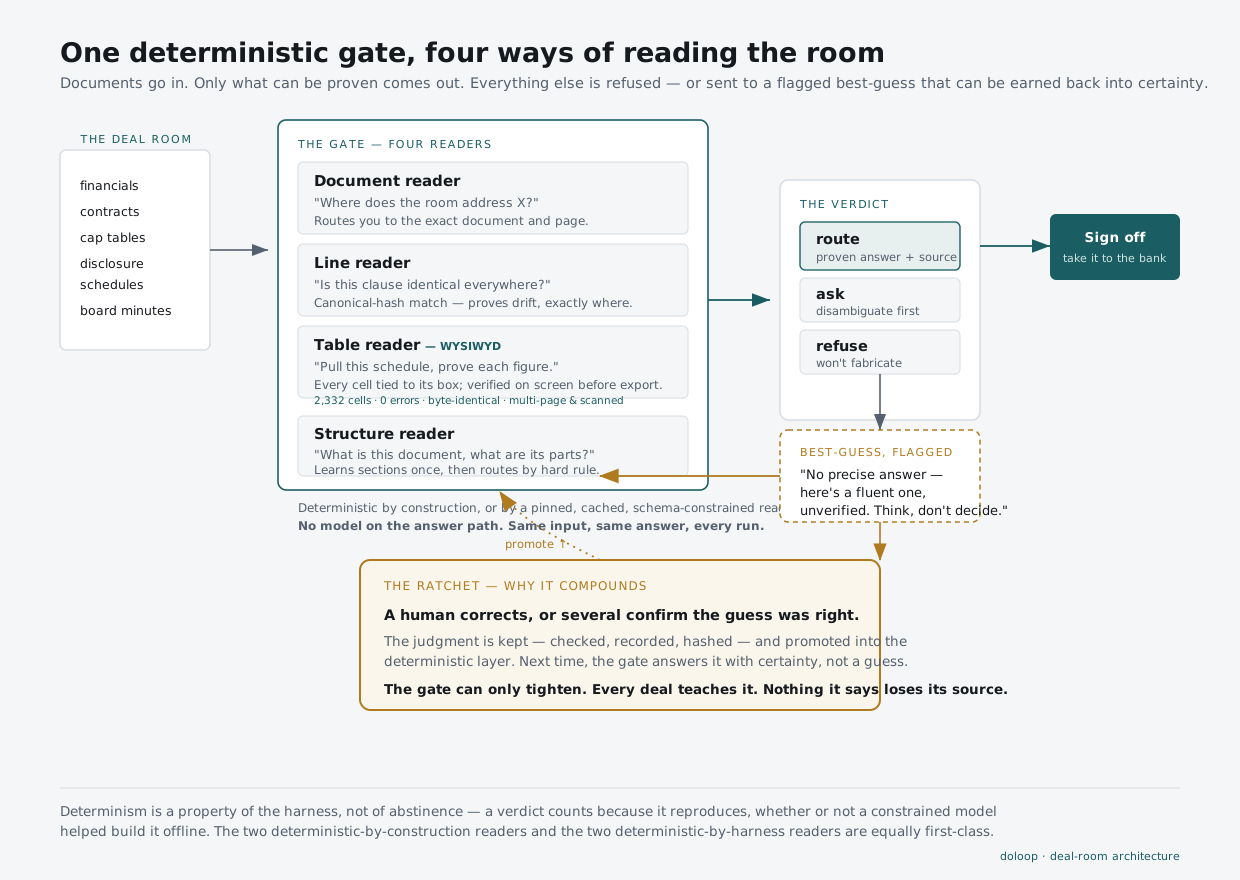
The proof
One changed word, surfaced exactly.
The clause reads the same to a tired eye at 2 a.m. It isn't — and that single word is what a dispute turns on.
Same input, same result, every run — so a finding is reproducible eighteen months later, in front of whoever is asking. That reproducibility is the difference between a citation and evidence.
Two kinds of answer — and you always know which
The tool never dresses a guess as a fact.
The answer you can sign off on
Exact, repeatable, traced to source. Use it for tie-out, disclosure schedules, and anything that has to hold up.
The answer to think with
When the room can't prove something and you still want a view, you can ask for a fluent best-guess — clearly marked as unverified. Use it to explore, never to decide.
That line — proven on one side, flagged on the other — is the whole point. A citation-based assistant gives you only the second kind, dressed as the first.
Why it compounds
It gets sharper with every deal.
When your team corrects something — or confirms a best-guess was right — that judgment is kept and applied next time: checked, recorded, and auditable. The questions the tool answers with certainty grow deal over deal, while everything it reports stays traceable to its source. Your work becomes the thing that makes the next deal faster, and it stays yours.
Provenance, consistency, and provable answers across the room — deterministically.
An exception, a house convention, a confirmed best-guess. The judgment, captured once.
Hashed, recorded, applied to every deal after — and never shared outside your firm.
See it run
A real report, on real filings.
All three live readers, run on the public Twitter / Musk merger documents, in one self-contained report — tables tied to pages, clauses checked for drift, questions answered or honestly refused. Nothing left the machine that produced it.
A hosted sample, seeded on the deal's own corpus, is in preparation. Want it on your documents? That's the design-partner conversation below.
What we don't claim
The honest fence.
We'd rather you trust the boundary than oversell past it. Three things we're explicit about:
- On the table reader, accuracy and reproducibility are settled against ground truth; recall — whether any cell was ever silently dropped — is the one remaining axis, and measurement is underway.
- The "know the document" reader is on our roadmap, shown above as concept — not yet shipped code. And the "find it" reader's depth on your deal depends on seeding it with your corpus first, a short attended step we do with you.
- Whether this closes your deals faster or catches more is the number we have not yet earned — it's exactly what we're looking for a design partner to establish with us, on real diligence.
Where it fits first
Financial tie-out and disclosure-schedule preparation.
The work where a wrong number carries real liability, and a junior team spends most of its hours cross-checking figures against source. doloop does that checking at the source, the first time, and produces the trail you'd have built by hand. The result you keep is one you can stand behind long after the deal closes.
Design partners
Verify your next deal room with us.
We're taking on a small number of design partners — M&A counsel and sell-side advisors who run a real verification pass and want it deterministic, defensible, and compounding. We'll seed the gate on your documents and run it alongside your team on a live deal.